Saturday, July 10, 2021

WHAT IS SECOND ORDER THINKING?

 Former World#1 shooter Apurvi Chandela had an underwhelming World cup in Mar '21. She couldn't win a medal & in her final shot she couldn't even squeeze the trigger within time limit. In 2020 Covid lockdown she focused on her fitness & lost 7 Kgs.It turned out that her improved fitness led to loss of performance.

How?

Shooters wear a specialised,weighted shooting jacket & trousers made of a thick, stiffened canvas. If your kit is a little loose or if it doesn't have strong support, then you have to work harder to stay perfectly still. Source: https://bit.ly/3ajX7oz

Apurvi went with the notion that the improved fitness would lead to improved performance. But it turned otherwise. This is First Order Thinking in action. First Order #Thinking is easy, it happens when we look for something that only solves the immediate problem without considering the consequences.

Second Order Thinking is deep, it moves beyond the immediate problem & considers the multiple layers of consequences of a given decision. Had Apurvi thought of effects of her weight loss and evolved her shooting jacket/trousers, it would be Second Order Thinking in action.

Find the summary of this high leverage concept in my sketchnote.

How would you use Second Order Thinking at work ?

My Sketchnote:

My LinkedIn Post:

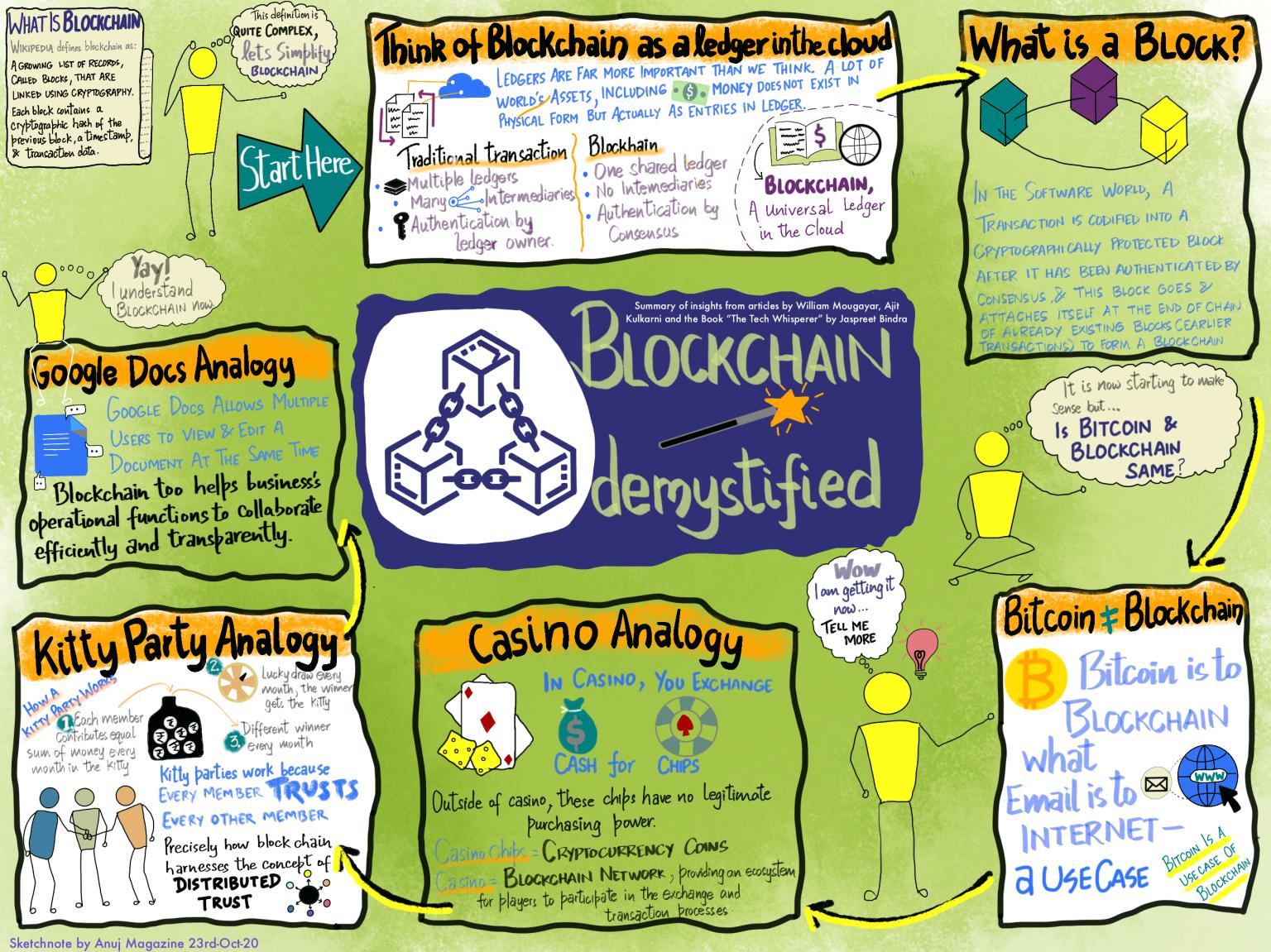
EXPLAINING BLOCKCHAIN TO A KID

 Cryptocurrency Exchange platform Coinbase went public this week, an event which is widely considered as a 'watershed event'.

As #cryptocurrency goes mainstream, more companies are jumping on the bandwagon. PayPal users can buy/sell/hold crypto directly via its service. Elon Musk recently said that Tesla was now accepting Bitcoin as a form of payment.

It's 'safe' to say that the concept of money, as we know it, is getting disrupted much the same way the advent of internet disrupted the world of information.

The technology that enables the existence of crypto is Blockchain.
It's always an interesting challenge to simplify an emerging tech like #Blockchain and explain it to a kid ?

Drawing inspiration from the examples in our day-to-day lives usually is of great help in simplifying a complex concept.

In the book, 'The Tech Whisperer' Jaspreet Bindra beautifully explains the concept of Blockchain using analogies such as Ledger, Kitty Party (yes you heard it right!) & says 'Bitcoin is to Blockchain what email is to Internet. A use case. Bitcoin is a use case of Blockchain.'

A few other analogies that i found useful were Casino and Google docs. Read more: https://bit.ly/3uV0xGm ,summary in my #sketchnote

How else would you simplify blockchain ?

My Sketchnote:


My LinkedIn Post:

TACTICS FOR FINDING FOCUS

 Sachin Tendulkar in one of his earlier interviews said-

"The toughest thing about batting is to clear your mind. The mind always wants to be in the past or in the future, it rarely wants to be in the present. My best batting comes when my mind is in the present but it doesn’t happen naturally, you have to take yourself there."

Like sportspeople- All of us in our day to day lives as professionals fight this daily battle for attention towards the tasks that matter. Our attention is split- be it deluge of notifications from slack, our chosen social media, myriad of emails or add to the list the distractions associated with working from anywhere. Our mind has the peculiar ability of wandering off at the first available moment, and it doesn't need any permission.

Geet Sethi in his book 'Success vs Joy' defines concentration is simply remaining in the present. But the key question is how do we return #focus to things that matter?

Some good ideas in this twitter thread https://bit.ly/3mERiaA that i find worth sharing (Summary in my sketchnote)
1 Eliminate Low-Value Decisions
2 Sprint, then Rest
3 Noise Cancellation
4 Sleep Tight
5 Train your Mind

What are your tactics to maximize the focus ?

My Sketchnote:

My LinkedIn Post:

HOW TO OLYMPIANS SET GOALS ?

 I was recently reading the book "Will It Make The Boat Go Faster?". This book is about an underdog story of Ben Hunt-Davis and his team's journey to Olympic gold in the men’s Rowing Eight at Sydney 2000.


They developed a whole new way of working and began challenging everything they did with the question: “Will It Make The Boat Go Faster?” If it did, they would keep doing it, if it didn’t they’d try something different.

By focusing on their performance (rather than results), their results started improving.

The team followed a peculiar goal setting approach known as 'Layered Goals'. The four layers included:
1. the crazy
2. the concrete
3. the control
4. the everyday layer

The crazy layer of your goal is, obviously, the outrageous one, a big bold goal.

The concrete layer provides the foundation. The concrete layer is where the crazy layer becomes specific. So, winning a gold medal results in rowing with certain time.

The control layer is about separating what you can from what you can’t control. e.g. You certainly can’t control the weather but you can control how often you would train.

the everyday layer, which included the actions we can do daily.

How do you think the layered goals approach can be used at work ?

My Sketchnote:


My LinkedIn Post:
Saturday, June 26, 2021

LEARNING HOW TO LEARN

 The creator of Ruby on Rails, David Heinemeier in an interview http://bit.ly/2ZWnOtm shares his profound thoughts on the subject of learning:


"You can get really good at most things, even if you start “late”, if you know how to learn..... I’ve realized that the hard part about most books is not reading them but recalling their knowledge or insight when you need it the most."

In today's fast-paced world, Learning is the only constant. 'Learning how to learn' is a skill that is a force-multiplier, yet it doesn't get as much mind-share as it ideally should.

Our learning strategies have to constantly evolve with time for us to be relevant. And at the same time, there are learning strategies that are timeless in nature. One such was suggested by Richard Feynman Nobel Prize winning American physicist.

The Feynman Technique (as it is popularly called) involves 4 key steps:

(1) Identify
(2) ELI5 ("Explain It To Me Like I'm 5")
(3) Reflect & Study
(4) Organize, Convey & Review
(source https://bit.ly/3mhZehr , summary in my sketchnote)

To me, the essence of this technique is in Step 2 i.e. to simplify your learning enough and make it comprehensible to a child.
Un-complexifying something is a super-power.

What are your preferred learning strategies ?

HOW TO FIND A MENTOR

In a podcast that i listened to recently, Raghu Raman shared an powerful anecdote:

During his early India Army days, once there was a general coming for briefing. The commanding officer (CO) suddenly looked at him and said- "You are going to conduct the briefing." He was stressed as the time was short and the fact that situation could explode if he messed up. He went through the intense preparation cycle and just before the presentation was about to begin CO indicated to him to sit down and instead CO himself started the presentation.

He could have felt "Why the hell did CO put him through that shit?" But that was the mentorship. He actually let Raghu go through the palpitations that are going to happen in the high risk presentation without actually the risk of doing that.

Teaching doesn't mean giving only lectures, it means how can I impart the lessons effectively.

Even if you are a rookie in your field or a successful pro, having the right mentor at right time adds immense value. But often people struggle in finding the right mentor.

"How does one find a mentor". I quite liked simple ideas shared in this tweet on finding a mentor https://bit.ly/2WB6LMB (Catch my sketchnote summary of this thread))

How have you leveraged mentorship in your career ?

My Sketchnote:


My LinkedIn Post:


ANTIFRAGILITY AS A COMPETITIVE ADVANTAGE

 India fast bowler Prasidh Krishna recently made his International cricket debut. He got belted for 37 runs in 3 overs. Everyone thought his career is over before it started but he came back, took 4 wickets in next 5 overs.

Another recent debutant, Suryakumar Yadav was a consistent performer in domestic and IPL circuit for many years but was often ignored for selection. It took a long time before he got his chance.

Both of them faced ups and downs but they didn't let it break them. A trait known as Antifragility binds them.

Being Antifragile helped them to deal with not only failures but also with the situations when they were successful, yet didn't get their due.

From the book "Antifragile: Things That Gain from Disorder":
"Some things benefit from shocks; they thrive & grow when exposed to volatility,randomness,disorder & stressors & love adventure, risk & uncertainty. Anti-fragility is beyond resilience or robustness. The resilient resists shocks and stays the same; the anti-fragile gets better."

Sahil Bloom in his profound thread https://bit.ly/3lTuvr1 calls Antifragility as a competitive advantage and brings to the fore many such traits. Summary in my sketchnote.

What's your take on Antifragility as a differentiating skill ?

My Sketchnote:

My LinkedIn post: